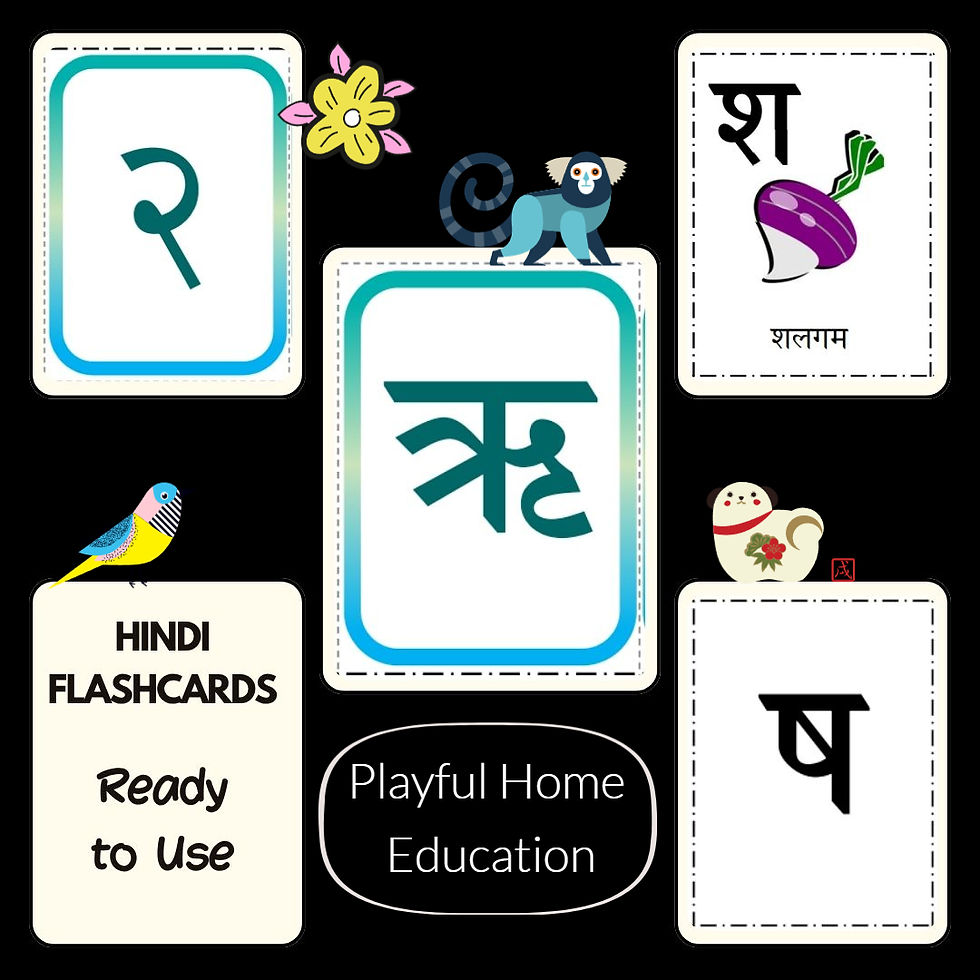
4 Fun Activities to Teach Hindi Vowels to Preschoolers Through Play
If your child is beginning to learn Hindi, try introducing the swar (स्वर) through playful activities. Children can start exploring Hindi through pictures, sounds, songs and simple games. These games require very little preparation and can be adapted to suit your child's interests and familiarity with Hindi.
You don't need to teach all the vowels at once. Start with two or three familiar letters, give your child time to explore them, and gradually introduce more.

Here are four games you can try at home.
1. Picture Matching: Match the Letter to the Picture
What you need: Hindi letter cards and picture cards.
This is a simple way to introduce the connection between a written letter and a word that begins with its sound.
How to play
Choose two or three Hindi vowels your child is familiar with or is beginning to learn.
Prepare one card for each letter and separate picture cards showing familiar objects whose names begin with those sounds.
Place the letter cards in front of your child.
Show one picture at a time. Say its Hindi name clearly and invite your child to find the matching letter.
Once your child has matched the cards, say the letter and the word together.
For example:
अ – अनार
आ – आम
इ – इमली
उ – उल्लू
You can make the game more challenging by placing all the picture cards together and asking your child to sort them under the correct letters.
What does this game help develop?
Picture matching encourages children to notice the relationship between a letter, its sound and a spoken word. It also provides opportunities to build vocabulary and practise visual recognition.
A little variation: Instead of giving your child the picture cards, ask them to find an object or picture in a storybook that begins with one of the letters.
2. Sound Hunt: Become a Hindi Sound Detective
What you need: Familiar household objects, picture books or a collection of pictures.
Children hear sounds in their everyday surroundings long before they learn to associate those sounds with written letters. A sound hunt encourages them to listen more carefully to the words they already know.
How to play
Choose one vowel sound that your child has encountered.
Say a familiar Hindi word beginning with that sound.
Ask your child to listen carefully and identify the sound at the beginning of the word.
Look around the house or through a picture book for other words beginning with the same sound.
Say each word aloud together, emphasising its beginning sound naturally.
For example, if you are exploring अ, you could begin with अनार. Look for other familiar Hindi words beginning with the same sound.
You can also turn this into a listening game. Say two words and ask your child whether they begin with the same sound or different sounds.
What does this game help develop?
Sound hunts encourage listening, attention to speech sounds and awareness of how spoken words begin. These are useful foundations for connecting spoken language with written letters.
A little variation: Play the game during everyday routines. While getting ready, travelling or looking through a book, invite your child to find a word beginning with the sound you are exploring.
3. Swar Sorting: Sort Pictures into Letter Baskets
What you need: Picture cards, letter cards and small baskets or containers.
Sorting is a natural way for children to explore similarities and differences. You can use this familiar activity to practise recognising Hindi vowel sounds.
How to play
Select two or three vowels your child has already encountered.
Place a letter card in front of each basket or container.
Prepare picture cards with familiar words beginning with those sounds.
Ask your child to say the name of each picture and place it in the basket belonging to the correct letter.
When all the cards have been sorted, go through the baskets together and say the words aloud.
For example, you could create separate baskets for:
अ – अनार
आ – आम
इ – इमली
Start with a small collection of pictures. Add more only when your child is comfortable with the activity.
What does this game help develop?
Sorting encourages children to compare, classify and identify similarities. When the sorting rule is based on beginning sounds, children also practise listening for differences between spoken words.
A little variation: Instead of using baskets, draw large letters on sheets of paper and ask your child to place the picture cards around the corresponding letters.
4. Say and Sing: Make Hindi Swar Musical
What you need: Your voice, a familiar tune and, if you like, simple rhythm instruments.
Music and rhythm can make language activities enjoyable and memorable. You don't need to compose a complicated song. A simple repeated pattern is enough.
How to play
Choose two or three vowels.
Say each letter clearly, followed by a familiar example word.
Repeat the sequence using a simple rhythm.
Invite your child to join in by saying the letters and words.
Clap, tap a table or use a small percussion instrument to create a rhythm.
For example:
अ – अनार
आ – आम
इ – इमली
उ – उल्लू
You can say the sequence slowly, repeat it faster, or pause before the word and let your child complete it.
You can also make it a listening game: say a word and ask your child to identify the vowel sound they hear at the beginning.
What does this game help develop?
Saying and singing words gives children opportunities to listen, repeat, notice sound patterns and become more familiar with the pronunciation of Hindi letters.
A little variation: Let your child take the lead. They can choose the next letter, make up a rhythm or decide which word everyone should sing.
A Few Tips to Make Hindi Vowels Learning Through Play Activities Easier
You don't need to turn every game into a formal lesson. A few simple principles can make these activities more enjoyable and useful.
Start small
Introduce a few letters at a time rather than presenting the entire set of vowels in one sitting. Give your child opportunities to revisit familiar letters before adding new ones.
Use words your child already knows
Familiar objects make it easier to connect a new written symbol with spoken language. Choose examples from everyday life, picture books, food, animals and things around the house.
Say the sounds clearly
When introducing a letter, demonstrate its sound through a familiar word. Letter names, spoken sounds and the names of example words are related, but they are not exactly the same thing. Give your child opportunities to hear and repeat the words naturally.
Let your child play with the materials
Cards can become sorting games, picture hunts, matching activities or pretend-shop items. Children don't always follow the activity in the way an adult expects. Allowing them to explore can create additional opportunities for conversation and learning.
Revisit letters in different ways
A child may recognise a letter in a matching game but find it harder to identify it in a book or on a sign. Encountering the same letter in different contexts gives them more opportunities to become familiar with it.
Keep it relaxed
The purpose is to build familiarity with Hindi letters and sounds, not to test how many letters your child can remember. If your child loses interest, stop and try again another day.
Make Hindi Learning a Listening Experience Too
Recognising a Hindi letter is only one part of learning to read. Children also need opportunities to hear how letters are pronounced and how their sounds occur in words.
This is particularly useful when parents are not confident about Hindi pronunciation themselves.
At Playful Home Education, our Hindi learning resources combine worksheets with audio guides that demonstrate the pronunciation of Hindi letters. Children can listen to the sounds while exploring the corresponding letters and completing activities.
Explore Hindi Worksheets with Pronunciation Audio Guides
Remember, worksheets, audio and games serve different purposes. They work best as complementary experiences, alongside everyday conversation, stories and playful exploration.
Hindi learning does not have to begin at a school desk. Sometimes, it can begin with a picture, a sound, a song or a little game at home.