How To Teach Sanyukt Akshar (Conjunct Consonants) to a Child?
Sanyukt akshar are two consonants joined without a vowel between them, like स्त in नमस्ते.
स् + त = स्त
With 33 consonants, and the possible combinations of joining them boggles the mind.
First thing, your child doesn't need to learn all of them at once.
Start with the joining rule, then a handful of common conjuncts, then the fixed-form exceptions, and learning Sanyukt Akshar will become manageable rather than overwhelming.
What exactly is a sanyukt akshar?
Every Hindi consonant carries a built-in vowel sound — क is "ka," not just "k." A sanyukt akshar happens when two consonants join together with no vowel between them, so the first one drops its vowel and changes shape slightly to join the second. In नमस्ते, स and त join to form स्त, with no vowel sound between the s and the t.
Why do consonants change shape to join each other?
The change is called removing the halant, and it happens in one of two ways. Consonants with a vertical line on the right lose that line and attach directly to the next letter (क + य = क्य). Consonants without a vertical line, like ट and ड, simply stack on top of each other instead. Once you show this pattern to a child, the shapes stop looking random (and nonsense) and instead of memorizing, the child can understand it conceptually.
However, there isn't just one rule — there are several, depending on which letters are joining. र behaves differently depending on whether it comes first or second in the pair. Although most consonants drop their vertical line and attach to the next letter, a few, like क and फ, drop a curve instead.
ह has its own pattern, where the second letter sits inside its shape.
Nasal sounds like ङ, ञ, ण, न, and म often skip the full conjunct altogether and become a dot above the letter instead.
Sanyukt akshar can feel inconsistent to an adult trying to explain them logically. They aren't one rule with exceptions, they're several small, learnable patterns, and a child doesn't need to know the linguistic reason behind each one to recognize it by sight and sound.

When should a child start learning sanyukt akshar?
This comes after varnamala and matras, not alongside them. A child needs to already read simple consonant-plus-vowel words comfortably before conjuncts are introduced. This is because sanyukt akshar involve removing a vowel sound the child has learned to expect, and then adding another consonant to the previous one.
What order should conjuncts be taught in?
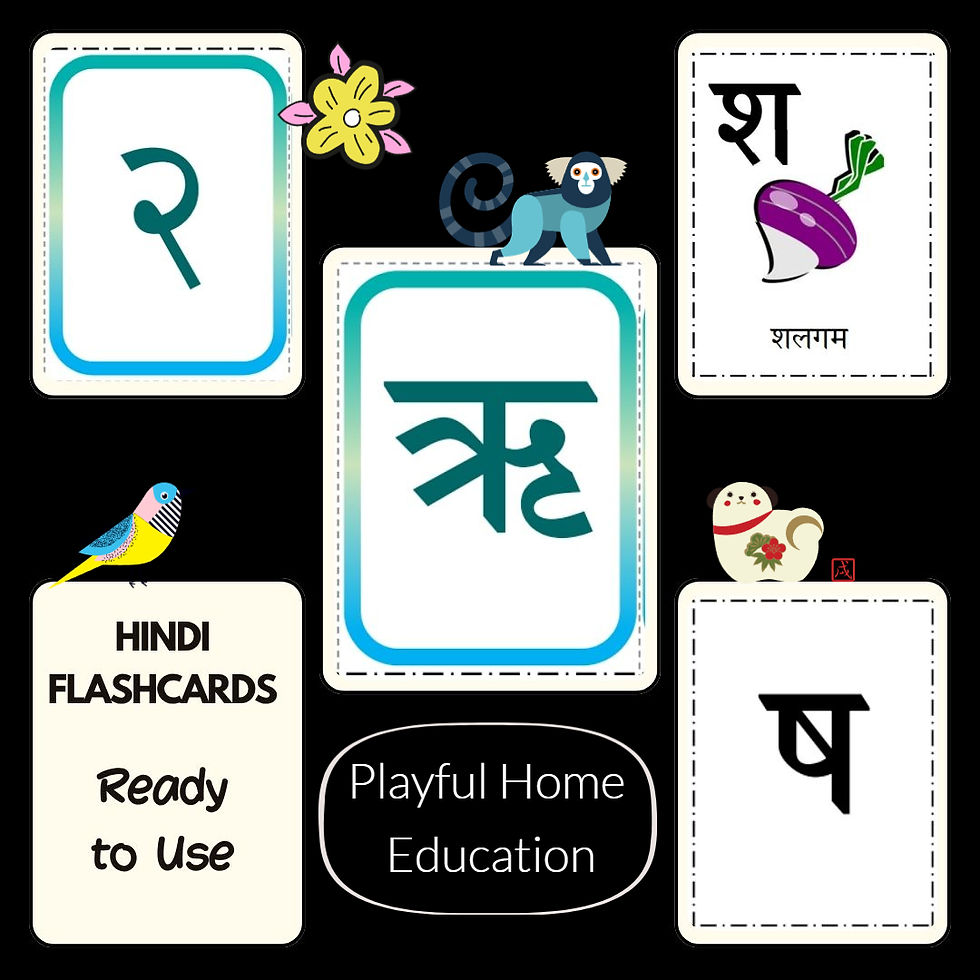
Start with the four conjuncts that are already familiar from the varnamala itself: क्ष, त्र, ज्ञ, and श्र. These are usually recognised before any formation rules are introduced, simply as shapes with fixed sounds.
After that, teach one pattern at a time, not the whole rule set together:
Teach now | Introduce later |
The four fixed forms: क्ष, त्र, ज्ञ, श्र | The "ra paden" pattern (र as the second letter, shown as a slanting mark under the first) |
The "ref" pattern — र as the first letter, shown as a small mark above the next letter | The ह-combination pattern, where the second letter sits inside ह |
The vertical-line-drop pattern (ख, ग, घ, and most other consonants) | Conjuncts with two acceptable written forms (क्क or क्क, ट्ट or ट्ट) |
The anuswar shortcut for nasal sounds joining the same varga (जंजीर instead of the full conjunct spelling) | Three-letter conjuncts, once two-letter ones are automatic |
This keeps the child working with one joining logic at a time, rather than meeting all eight patterns at once and trying to guess which applies where.
How do you actually teach the joining, not just the shape?
Say the two sounds separately first — स, then त — then say them fast together until they blend into स्त. Point to the two individual letters, then to the joined form, so the child sees where each part went. Only after the sound and the visual link feel solid does writing the joined shape make sense.
After teaching a few easy ones, you can proceed to teaching the whole set. For this, discussing the pattern is important. Say the two sounds separately first, then blend them, the same as before — but now point out which pattern is at play. Is the first letter losing its line? Is र sitting above or below? Is this one of the four fixed forms that doesn't follow a pattern at all?
Naming the pattern, even in simple terms ("this one drops its tail"), gives the child something to recognise the next time a similar conjunct appears, rather than treating every new conjunct as a fresh shape to memorise.
Try this today
Pick one common conjunct your child already hears in a word — स्त in नमस्ते works well.
Say the two separate sounds slowly: स... त...
Say them faster, several times, until they blend into one sound.
Show the two individual letters side by side, then the joined form.
Ask your child to find the same conjunct in one more familiar word.
Activities for Sanyukt Akshar Learning
1. Letter Snap: Write single consonants on separate cards. Child flips two cards at once and they must say aloud the sound of blending the two consonants. If they succeed, they keep the pair. If not, the opponent takes the cards. The one with most cards wins. Start with easy letters.
2. Conjunct Hunt: Give your child a familiar storybook and ask them to circle or point to any joined letters they spot. Turns spotting sanyukt akshar into a search game.
3. Building Blocks: Write consonant halves (the ones that lose their vertical line) on small blocks or chits, and the joining consonant on separate ones. Child physically slides the two together to "build" the conjunct. This makes the abstract joining rule sensory and easy.
4. Say It Fast Race: Say two separate sounds slowly, then challenge your child to say them faster and faster until they blend into the conjunct sound. Works well as a silly, giggly game.
5. Memory Match: Classic memory-card game, but pairs are a conjunct and the word that contains it (स्त ↔ नमस्ते, त्र ↔ पत्र). Matches sound recognition to real vocabulary instead of isolated letters. Make 20 rectangular cards. Write 10 conjuncts and 10 words that contain those conjuncts. Turn them over in a 5X4 layout and play like memory game.
6. Playdough Joins: Roll playdough into the shapes of two consonants, then physically press them together to form the conjunct shape. Especially useful for children who need a hands-on, sensory route into the visual joining pattern.
Rules of conjunct formation (from PHE Sanyukta Akshar Worksheet)
The four introductory conjuncts क्ष, त्र, ज्ञ, and श्र are taught first, before the formation rules — as fixed forms a child simply recognises.
Rule 1 — Adding र् (the "ref") When र is the first consonant in a conjunct, it doesn't keep its full shape. It becomes a small curved line sitting on top of the next letter (कर्म → कर्म shown as र् + म). This form is called "ref."
Rule 2 — Adding a consonant before र (the "ra paden") When र is the second consonant in a conjunct, the first consonant takes a small slanting line or inverted-v shape underneath it, and र doesn't appear in its usual form at all (प् + र = प्र, as in प्रण).
Rule 3 — ऋ is a separate caseThe ऋ matra (as in मृग) uses its own curved mark ("rru ki matra") and isn't related to either ref or ra paden, even though all three involve small marks rather than the full letter shape.
Rule 4 — Letters with a vertical line drop that line Most consonants — ख ग घ च ज झ ण त थ ध न प ब भ म य ल व श ष स — have a vertical stroke on the right. When these join another consonant, that vertical stroke is removed and the remaining shape attaches directly to the next letter (ख + य = ख्य).
Rule 5 — क and फ drop the curve instead These two don't have the same vertical-line structure, so they lose the curved part on the right instead (क् + त = क्त, also written with an alternate form).
Rule 6 — Some conjuncts have two acceptable written forms A few consonant pairs can be written either as a stacked/side-by-side combination or as a single fused symbol, and both are correct.
Rule 7 — ह has its own joining pattern When ह combines with certain consonants, the second letter sometimes sits inside the shape of ह itself, rather than beside or below it (ह् + न → चिह्न).
Rule 8 — Nasal consonants use the anuswar shortcut ङ, ञ, ण, न, and म, when joined to another consonant from the same varga (row), aren't written as full conjuncts. Instead, they're shown as a dot (anuswar, ं) above the preceding letter (न् + त = अन्त, commonly written and read as अंत).
Three-letter conjuncts follow the same building-block logic Once two-letter joining is familiar, three consonants can combine in sequence using the same rules above, layered (स् + थ् + य = स्थ्य, as in स्वास्थ्य).
FAQ
Do all Hindi consonants combine to form new conjunct letters that look different from the parts?
No. Most conjuncts follow one of two visual joining rules, but a small number — क्ष, त्र, and ज्ञ — have their own fixed shapes that don't clearly show their two original letters.
Is ज्ञ pronounced the way it looks?
Not quite. Though it's written as ज + ञ, it's actually pronounced closer to ग्य (gya), a quirk that comes from how the sound shifted over time in Hindi. It is pronounced differently in Sanskrit and Marathi. But in Hindi, its spoken sound is closer to gya (with a nasal sound).
My child mixes up similar-looking conjuncts. Is that normal?
Yes, this is common at first, since several conjuncts share similar strokes. Slow down on the verbal sound-blending step, then slowly proceed to the written shape through reading and identification, and finally writing. This usually helps.
Should we teach with sanyukt akshar worksheets?
The sound-then-shape sequence above should come first. Worksheets work best as practice once a child can already blend the sound verbally, not as the first introduction to a new conjunct. Start first with the spoken sounds through conversations and story narration, then proceed to worksheets.

Related reading
Try this next: Sanyukt Akshar Worksheets Delivered to Your Home!
If your child is ready to move from varnamala to learning conjuncts, the Level 3 Sanyukt Akshar Mastery Bundle covers this stage in the same small-step sequence.