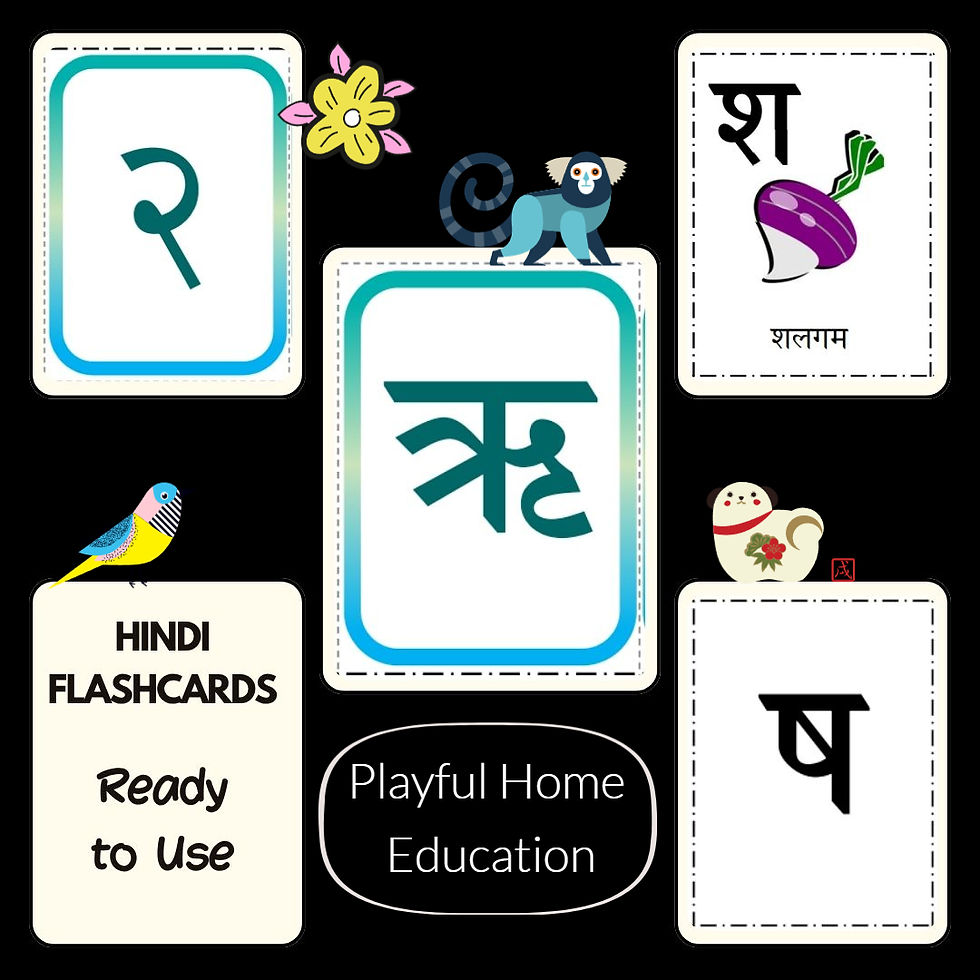
Hindi Swar for Kids: Difference Between ए, ऐ, ओ and औ Sounds
When children begin learning Hindi स्वर (vowels), some sounds can be a little confusing. Four vowels that are particularly useful to practice are ए, ऐ, ओ and औ. These sounds are often difficult for non-native Hindi speakers as well.
Although they may sound similar at first, each has a distinct pronunciation. Learning to hear these differences helps children recognize letters, connect them with words and build a foundation for Hindi reading.

Let's look at them one pair at a time.
1. ए and ऐ – Two Different Sounds
Both ए and ऐ are produced towards the front of the mouth, but the mouth opens differently for each sound.
ए – A relatively close, steady vowel sound. The mouth is moderately open, with the tongue positioned relatively high.
Example: एड़ी
ऐ – A more open vowel sound. The jaw drops a little further and the mouth opens wider.
Example: ऐनक
Listen to the audio examples below to hear the difference between these two sounds. Focus only on the first syllable of each word when they are spoken.
Audio for ए
Here, the words spoken are: केला, पेड़, सेना
Audio for ऐ
Here, the words spoken are: पैसा थैला मैं
Try saying एड़ी and ऐनक slowly. Notice how your mouth moves differently when you pronounce the two vowels.
2. ओ and औ – Two Different Sounds
ओ and औ are produced towards the back of the mouth, with rounded lips. The main difference is how open the mouth is.
ओ – A relatively close, steady vowel sound, produced with rounded lips.
Example: ओखली
औ – A more open vowel sound, with the jaw dropping further while the lips remain rounded.
Example: औरत
Listen to the audio examples below.
Audio for ओ
Here, the words spoken are: घोड़ा, बोला, रोटी
Audio for औ
Here, the words spoken are: मौसी, चौथी, पौधा
Try saying ओखली and औरत slowly. Pay attention to the difference in your jaw position and the shape of your mouth.
Hindi Swar for Kids: Help Them Hear the Difference
Here are three simple ways to practise these sounds together:
Listen and repeat: Say the words or vowel sounds and encourage your child to repeat the words. There is no need to rush.
Look in the mirror: Say the words together and observe how your mouth opens and how your lips move.
Play a listening game: Say one of the example words and ask your child to identify the vowel they hear.
Remember, young children benefit from hearing sounds in meaningful words and everyday conversations. Keep the practice light and enjoyable rather than turning it into a test. Hindi swar akshar are the first step in the journey of Hindi learning for kids.
Want to practice more Hindi sounds?
Explore our Hindi worksheets and learning resources at Playful Home Education to help your child become familiar with Hindi alphabet through enjoyable, age-appropriate activities.