Panchpadi Lesson Planning: The 5-Step Teaching Sequence in NCFSE 2023
Updated: Jul 28
Who this article is for
This article is written for:
School teachers in India
B.Ed / D.El.Ed students
Candidates preparing for CTET, TET, KVS, NVS, DSSSB, State PSC teacher exams
Candidates appearing for teaching interviews or demo classes
NCF or NCF-SE 2023 refers to the National Curriculum Framework for School Education (NCFSE) released by NCERT. This article will help you use Panchpadi from NCFSE 2023 correctly in lesson planning, classroom teaching, and interviews.
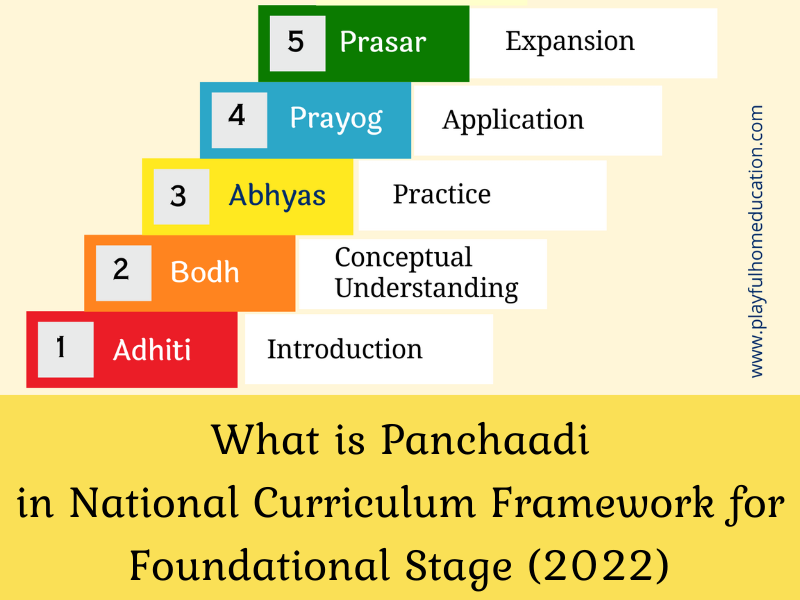
You may first read our detailed explainer of Panchaadi/Panchpadi Learning Approach here as detailed in the 2020 documentation:
You can also try the QUIZ here:

Here in this article, we use the inputs from the documentation provided by NCERT in 2023 to frame how to plan lessons with this approach, with example of lesson plans.
What is Panchpadi in NCFSE 2023?
Panchpadi means a five-step teaching process recommended in the National Curriculum Framework (NCF) 2023.
NCF suggests that learning should not be random or rushed. A good lesson should move through five clear stages, from preparing the child to reflect on learning.
In simple words, Panchpadi answers this question:
How should a teacher plan and sequence a lesson so that children understand, engage, and remember?
NCF places Panchpadi inside lesson planning, not as an activity by itself.
The goal of Panchpadi is that sharing and enhancing knowledge strengthens learning, and teaching makes learning clear and long-lasting
The Five Steps of Panchpadi
Below is the Panchpadi sequence as explained in NCF:
1. Aditi – Preparing the learner
(Aditi = introduction / readiness)
This step prepares children mentally and emotionally for learning.
Action: The Teacher introduces a new concept/topic.
Method: Establishing a connection with the child’s prior knowledge.
Student Engagement: Children gather relevant information by asking questions, exploring, and experimenting with ideas and material (with the help of the Teacher).
What a teacher does:
Connects the topic to children’s daily life
Revises what children already know
Sparks curiosity
Examples:
Asking a question
Showing a picture or object
Sharing a short story or situation
Purpose:
Children should feel “I know something about this”.
2. Bodha – Building understanding
(Bodha = understanding the concept)
This is the main teaching stage.
Action: Children try to understand core concepts.
Method: Through play, inquiry, experiment, discussion, or reading.
Teacher Role: The Teacher observes the process and guides the children.
Goal Alignment: The teaching plan details the list of concepts to be learnt by the children.
What a teacher does:
Explains or demonstrates the concept
Uses concrete materials (objects, charts, stories)
Encourages children to observe and think
Examples:
Counting real objects
Reading a story aloud
Demonstrating an experiment
Purpose:
Children understand, not memorise.
3. Abhyasa – Practice and application
(Abhyasa = practice)
Children now practice what they learnt.
Action: Practice to strengthen understanding and skills.
Method: Through a range of interesting activities.
Reinforcement: Teachers can organise group work or small projects to reinforce conceptual understanding and attainment of Competencies.
What a teacher does:
Gives guided practice
Allows children to try on their own
Encourages peer interaction
Examples:
Worksheets after concept clarity
Pair or group work
Oral practice
Purpose:
Learning becomes stronger through doing.
4. Prayoga – Real-life use
(Prayoga = application in real situations)
Learning is connected to real life.
Action: Applying the acquired understanding.
Method: In the child’s everyday life.
Delivery: Accomplished through various activities and small projects.
What a teacher does:
Links learning to home, school, or surroundings
Encourages children to apply learning outside class
Examples:
Finding shapes in the classroom
Counting steps or objects at home
Using new words in conversation
Purpose:
Children see why learning matters.
5. Prasar (Expansion):
Objective:
Spreading the acquired understanding (Pravachan) and using other resources to learn further (Swadhyay).
• Pravachan (Spreading Understanding):
◦ Mediated through peer learning.
◦ Examples include: Conversations with friends, telling new stories, singing new songs, reading new books together, and playing new games with each other.
• Swadhyay (Learning Further):
◦ Mediated through engaging with materials and experiences related to learning.
Application:
Supports metacognition, peer learning, curiosity, and lifelong learning habits
Another part of prasar is also to look back at learning.
What a teacher does to facilitate prasar:
Asks reflective questions, gives feedback
Observes understanding
Provide additional resources for self-study
Help create expansion opportunities
Examples:
“What did we learn today?”
“What was easy or hard?”
Teacher notes children’s responses
Learning is shared and becomes meaningful and remembered.
Here are the complete guidelines from NCERT.

Panchpadi as a Lesson Planning Tool
Panchpadi is not an activity. It is a lesson structure.
A Panchpadi-based lesson plan usually includes:
Learning outcomes (what children should learn)
Teaching-learning materials
Steps arranged in Panchpadi order
Assessment and feedback
A Simple Panchpadi Lesson Plan Template
Here is an example of lesson planning using these principles of Panchpadi. You can adapt this format for other lessons and subjects too.
Topic: Counting numbers 1–5
Class: LKG / Class 1
Time: 30 minutes
Aditi: Teacher shows real objects (blocks, fruits) and asks children to count what they already know. You can ask a child to give one fruit or one pencil to their friend. You can show 2 fingers and ask them to count.
Bodha: Teacher demonstrates counting from 1 to 5 using objects and number cards. This is the step where you impart the new knowledge, in the traditional sense.
Abhyasa: Children count objects individually and match numbers to quantities. Here, number games, art-integrated techniques are useful for smaller children instead of dry, boring practice.
Prayoga: Children count classroom items (chairs, bags) and for small children, this can also be play-based. Playing shopkeeper is a good way to practice numeracy.
Prasar: Teacher asks children what they learnt, what they counted, where counting can be useful, and observes responses. The teacher helps children create artistic or playful activities with numbers. This needs to be more interactive with the teacher, where kids can come up with creative ways and think and express freely.
3 Mini Examples for Interviews and Demo Classes
Example 1: Language (Story reading)
Aditi: Talk about children’s favourite animals
Bodha: Read a short story with pictures
Abhyasa: Ask children to retell parts
Prayoga: Connect story to real animals they see
Prasar: Ask what they liked in the story and enact play.
Example 2: EVS (Plants)
Aditi: Ask about plants at home
Bodha: Show pictures of parts of a plant
Abhyasa: Label parts
Prayoga: Observe plants in school garden
Prasar: Discuss with peers what plants need. Sing songs or play games about plants.
Example 3: Maths (Shapes)
Aditi: Ask children to name shapes they know
Bodha: Show real objects of shapes
Abhyasa: Sort shapes
Prayoga: Find shapes in the classroom
Prasar: Reflect on shapes found, discuss with peers about shapes of everyday things. Shape based games can be played. Performance arts, visual arts and play activities based on shapes.
Common Mistakes Candidates Make (Avoid these)
Jumping directly to Q&A or worksheets or practice (no Aditi or Bodha)
Teaching only through explanation (no Abhyasa or Prayoga)
No reflection or feedback at the end
Treating Panchpadi as a rigid rule instead of a flexible guide
NCF clearly encourages flexibility, not mechanical teaching.
Example Question on Using Panchpadi
Question: How do you plan a lesson as per NCF 2023?
Answer: I plan lessons using the Panchpadi approach, which moves from preparation to understanding, practice, real-life application, and expansion. This helps children learn meaningfully and not by rote.
Why Panchpadi Improves Learning (1–2 line answers)
It respects how children learn step by step
It connects learning to real life
It supports understanding over memorisation
It aligns teaching with assessment
Conclusion
Panchpadi is not a new burden for teachers. It is a clear, child-centred, efficient way to plan lessons. If you understand the logic behind the five steps, you can:
Plan better lessons
Handle interviews confidently
Conduct effective demo classes
Align your teaching with NCF 2023
Glossary
NCFSE (National Curriculum Framework for School Education): A national guideline for what and how children should be taught in schools
Pedagogy: The method or way of teaching
Learning outcomes: What a child should know or be able to do after learning
Formative assessment: Ongoing assessment during learning (observation, questions, feedback)
Mindmap of Panchpadi Framework

NCF-SE 2023 Presentation Slides
Download Presentation Based on NCF-SE 2023 (Created by NotebookLM from Google)